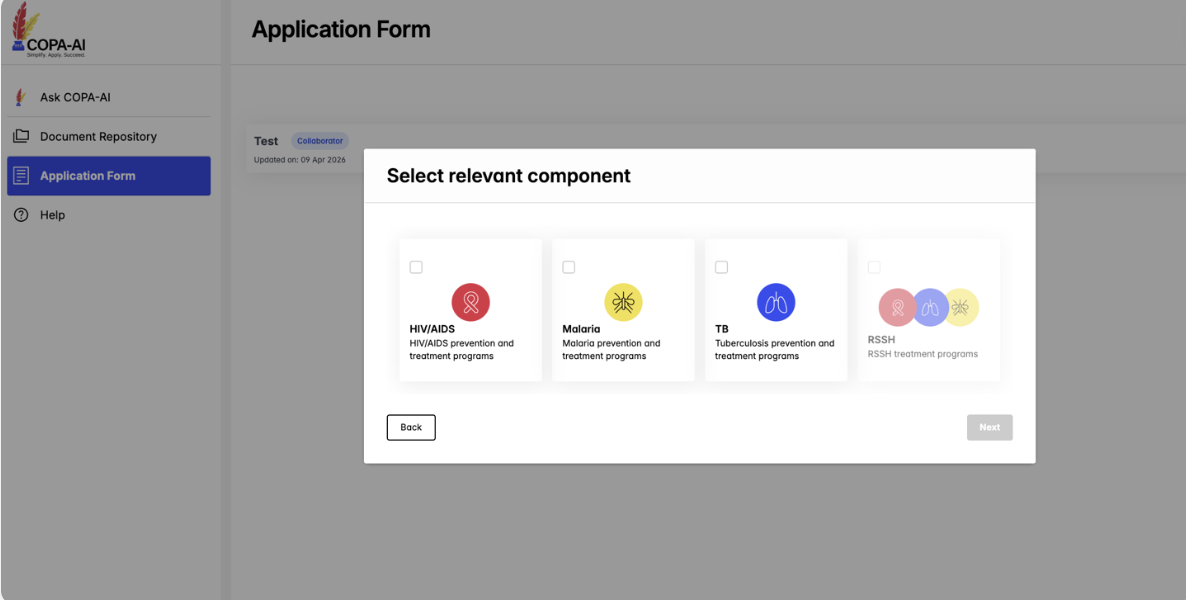
Every three years, eligible countries seeking Global Fund financing for HIV, tuberculosis, malaria and resilient and sustainable systems for health (RSSH) prepare comprehensive applications to apply for funding. For Grant Cycle 8 (GC8), an AI-enabled application called COPA, a Country-Owned Application Planning Assistant, was specially designed to support countries applying for funding. Funded by the Bill & Melinda Gates Foundation and operationalized by Bluesquare, COPA has supported users in more than 40 countries.

The COPA-AI home screen: attach files, start a new application form draft or continue an existing one.
A Funding Request combines a large body of evidence with strategic choices made by countries seeking this financing. Keeping this information aligned over this application process can be challenging.
A Funding Request draws on national plans, epidemiological analyses, intervention choices, Budgets, Performance Frameworks, Programmatic Gap Tables and detailed narrative sections. It reflects a country’s priorities and context, while responding to its requirements, investment priorities, terminology and guidance.
Many people contribute to a Funding Request and its supporting documents. A change in one priority, target, budget or intervention can easily create inconsistencies elsewhere. Reviewing and reconciling this information takes time for countries and reviewers. COPA was created to help address this challenge.
COPA helps applicants bring together source documents, data and narrative, while keeping every judgment and final decision with the country. Its development path, safeguards and purpose-built features shape how it is used.
COPA was initially developed by McKinsey & Company with funding from the Bill & Melinda Gates Foundation. Bluesquare subsequently completed, strengthened and operationalized the application. Its develelopment included direct engagement with the Country Coordinating Mechanisms. More than 45 users across 14 countries contributed, including through in-country visits to Senegal, Malawi, Zambia, Mozambique and Togo, and dozens of working sessions. This feedback, together with the onboarding and adoption support that followed, helped adapt COPA to country needs and working practices.
COPA allows users to securely bring together documents and structured information that underpin a Funding Request. It then generates draft narrative sections based on those source documents, provides traceability to the original material and supports consistency checks across the Funding Request. Every output is a first draft: applicants remain responsible for reviewing, validating and finalizing all content before it is included in the Funding Request.
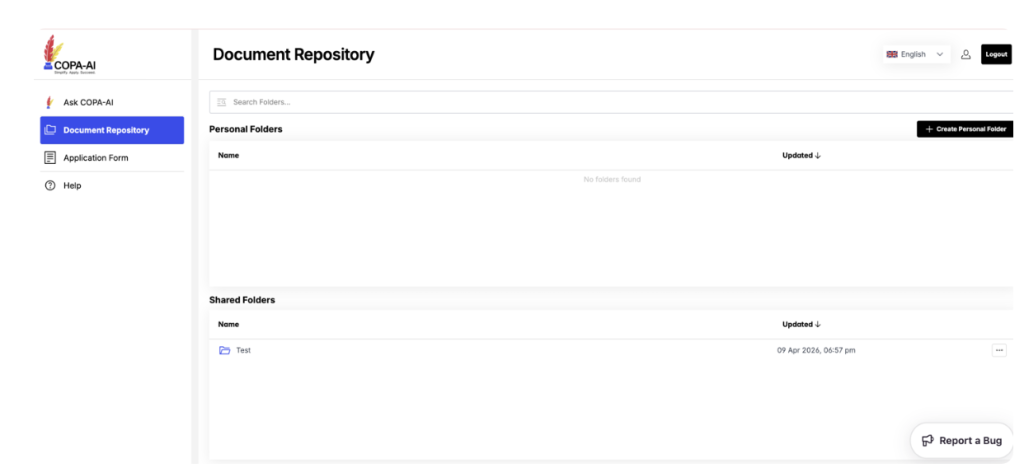
The Document Repository, with personal and shared folders.
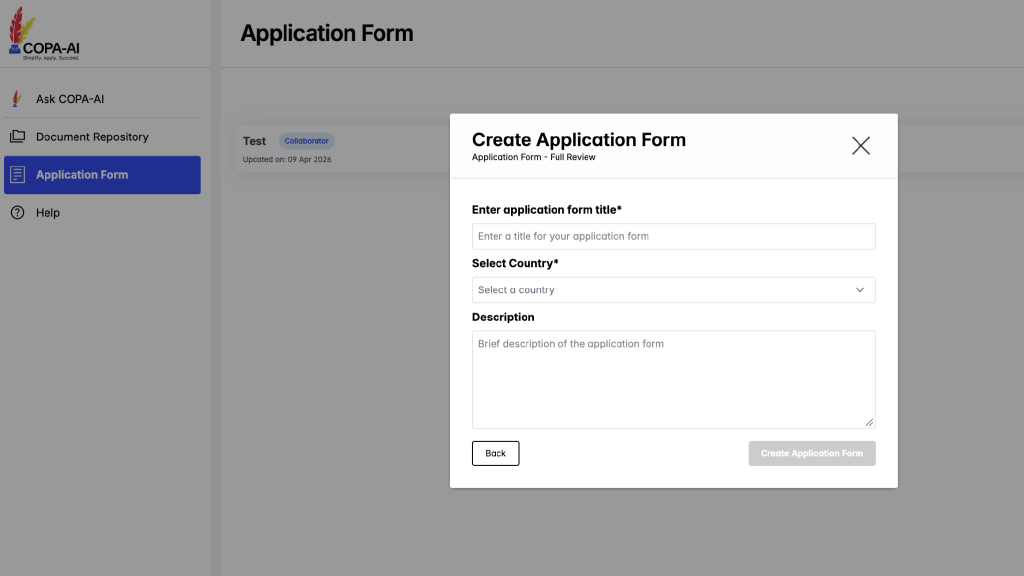
Creating an application form: title, country and description.
COPA was purpose-built for the Funding Request process with:
These features help applicants translate their own strategies, evidence and planning decisions into a coherent Funding Request, while retaining ownership of the content and decisions.
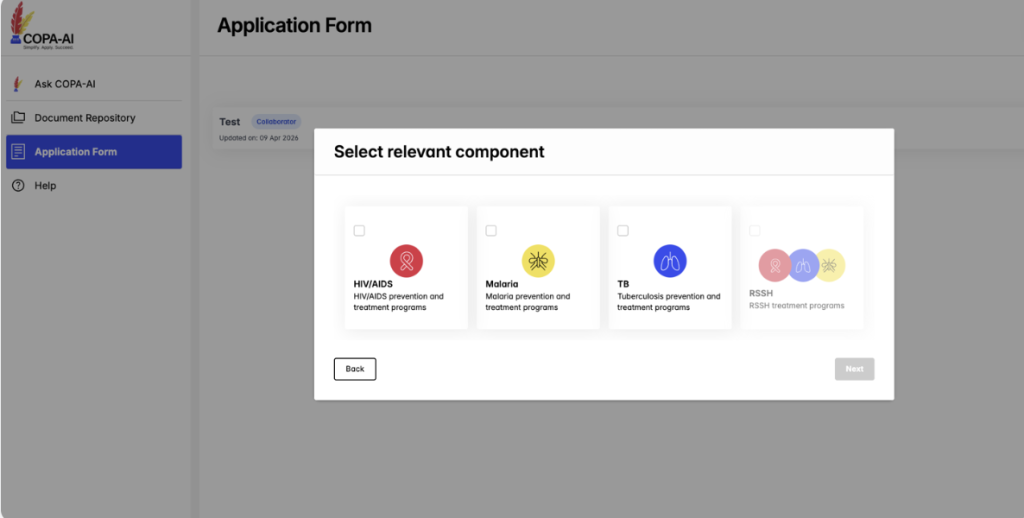
Selecting the relevant component: HIV/AIDS, TB, malaria or RSSH.
COPA was intentionally designed with safeguards to protect country documents. Uploaded documents were encrypted and scanned for security threats, and included safeguards confirmed by an independent cybersecurity audit. In addition, content uploaded to COPA is not used to train any AI models. That combination (a controlled environment, protected national documents, and work anchored in the relevant program and funding context) is what made institutional adoption possible.
Bluesquare is also developing a malaria Subnational Tailoring (SNT) platform that helps countries visualize risk stratification, simulate intervention scenarios and optimize intervention choices against available budgets. Connecting the two tools could help countries compare national strategies with evidence-informed intervention scenarios. The option identified by the model may not always be the best fit for a country’s context, where social, political, operational and data considerations also inform decisions. In turn, SNT planning outputs could provide a strong foundation for completing Funding Request materials.
Bluesquare broader approach aims to connect planning, evidence, data, AI and implementation workflows. Its teams bring experience in designing, deploying, maintaining and supporting digital and AI solutions in different country contexts, including in malaria programs.
Bluesquare welcomes conversations with funding institutions, ministries and partners interested in strengthening administrative and planning processes through secure, context-aware technology, and in building this ecosystem together. To start the conversation, explore Bluesquare’s technical assistance services.


