Most ministries of health already run several information systems for stock, consumption and health services. The data exists, but it sits in separate tools, so a stockout often becomes visible only when patients feel it. An early warning system for the health supply chain links these tools, adds analysis and alerts on top, and shows every level of the health system what needs action. Bluesquare supports ministries of health in setting up this type of system without adding a competing tool or replacing past investments.
A typical ministry of health combines an LMIS, DHIS2, an ERP for the central medical store, a quantification tool and a set of Excel files. Each tool answers part of the question. Together, they leave decision makers with fragmented data, uneven data quality, limited visibility on the last mile and decisions that react to problems instead of anticipating them.
Bluesquare therefore starts from what is in place. The early warning system connects existing tools, adds a data and alerting layer on top, and gives national, regional, district and health facility teams the information they need. Existing tools remain the place where data is entered and managed.
The approach follows 5 steps, each agreed with the ministry and its partners.
The work begins with a scoping workshop with the ministry and stakeholders. Teams identify the use cases at national, regional, district and health facility levels, then map the data involved: sites, products, orders, deliveries, stocks, logistics reports and epidemiological data, with their update frequency and reliability. Indicators, calculation rules and alert thresholds are agreed at this stage.
Interoperability is the foundation of the system and a core part of Bluesquare’s work with health information systems. Secure APIs and automatic extractions connect tools such as DHIS2, mSupply, Sage X3, OpenLMIS, QAT and SMT. These tools are examples: the system can connect to any tool a ministry uses.
Shared reference lists keep the data consistent. They cover products, health facilities and geographic divisions, and they follow the official nomenclatures of the ministry. An automated quality control checks completeness, accuracy and logical consistency for every batch of data. Our data management services cover this integration work.
The data layer combines 3 types of analysis.
Automated stock calculations work out minimum and maximum levels from average monthly consumption, delivery lead times and safety stock. They flag stockouts, overstocks, products close to expiry and sleeping stock, and attach an operational recommendation such as restocking or redistribution.
Triangulation of logistics and epidemiological data compares what the supply chain reports with what clinical data predicts. For a product covered by a health program, the system compares stock movements with the consumption expected from the number of cases treated and the standard treatment dose. A large gap points to losses, under-reporting of cases, data errors or practices that depart from protocols, and it triggers an investigation.
Predictive modeling anticipates stockout risks by modeling consumption trends. In Côte d’Ivoire, this component starts as a prototype on a data sample, comparing time-series and machine learning approaches, followed by a feasibility report before any integration into the workflow.
Each alert follows rules agreed with the ministry: thresholds, and recipients at national, regional, district and health facility levels. A manager validates the alert before it moves forward. A feedback loop then closes the cycle: automated checks read the updated data in the source tools to confirm whether the problem has been resolved. Alerts carry a status (open, in progress or resolved), so each level can follow what remains to be done.
Rules agreed with the ministry
Stock months on hand
Alert below 2 MOH
Recipients
Each alert carries a status
Out of stock risk
Stock at 1.2 months on hand
Manager follow-up
Sees the alerts of the team
Feedback loop
Automated checks read the updated data in the source tools to confirm whether the problem has been resolved.
Source tools
Stock levels updated
Automated checks
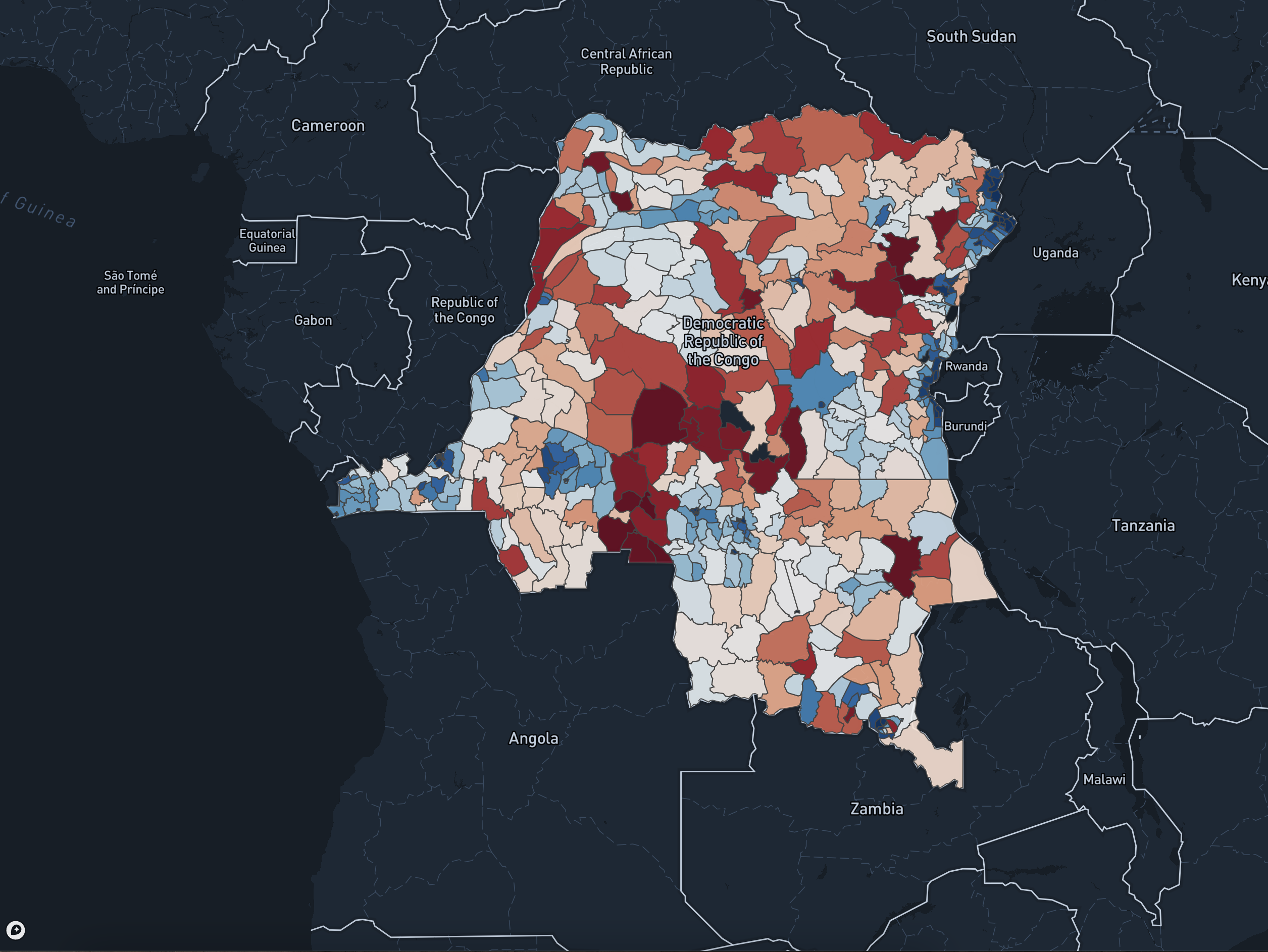
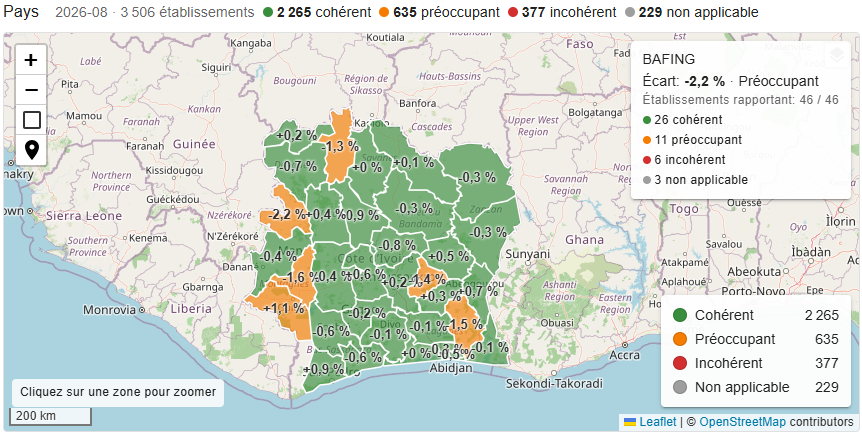
The visualization layer offers dashboards per health program (malaria, HIV, TB, nutrition, family planning and others) and per region, district and health facility. A heat map of the country lets users zoom in from the national level to a single facility.
Bluesquare connects these views to the national health facility registry, often called the carte sanitaire. As a leading provider of georegistry and health facility registry tools, Bluesquare keeps facility names, locations and hierarchies aligned across all connected systems.
This example is for illustration purposes only and uses fictional data. Bluesquare never shares partner data without their consent.
All the analysis, alerts and dashboards live in 1 platform. Every employee of the ministry and its partners can use it, with access levels set by login and password: a data manager for the Malaria program sees only Malaria related data, a district pharmacist sees the district, and national teams see the full picture. The platform can run in the cloud or on local servers, according to the ministry’s preference. Bluesquare also offers on-premise hosting.
The pitch is simple: your systems become interoperable, a data and alerting layer sits on top, and every level of your health system receives the early warning it needs. Nothing you have already invested in is replaced.
In Côte d’Ivoire, Bluesquare supports the Ministry of Health, Public Hygiene and Universal Health Coverage in building an early warning system for stockouts and expiries of essential medicines, as part of the Universal Health Coverage rollout. The work is financed by the World Bank through the Health, Nutrition and Early Childhood Development Program (PSNDPE).
The system will connect the tools already in use in the country: mSupply, DHIS2, eSIGL, Sage X3, QAT and complementary Excel files. The proposed rules will raise an alert when stock falls to or below the minimum level, when it exceeds the maximum level, and when a product expires in less than 90 days at health facility level or less than 180 days at central level. The project covers essential medicines first, with a possible extension to vaccines and blood products. This work has started in September 2026.
Is your ministry looking for earlier signals on stockouts, expiries and consumption anomalies, without adding another system to maintain? Contact Loïc Vervoort, Practice Lead for Health Logistics (lvervoort@bluesquarehub.com), or Wilfried Akre Oro, Country Lead for Côte d’Ivoire (woakre@bluesquarehub.com), to discuss your early warning system. You can also read more about our technical assistance for ministries of health.