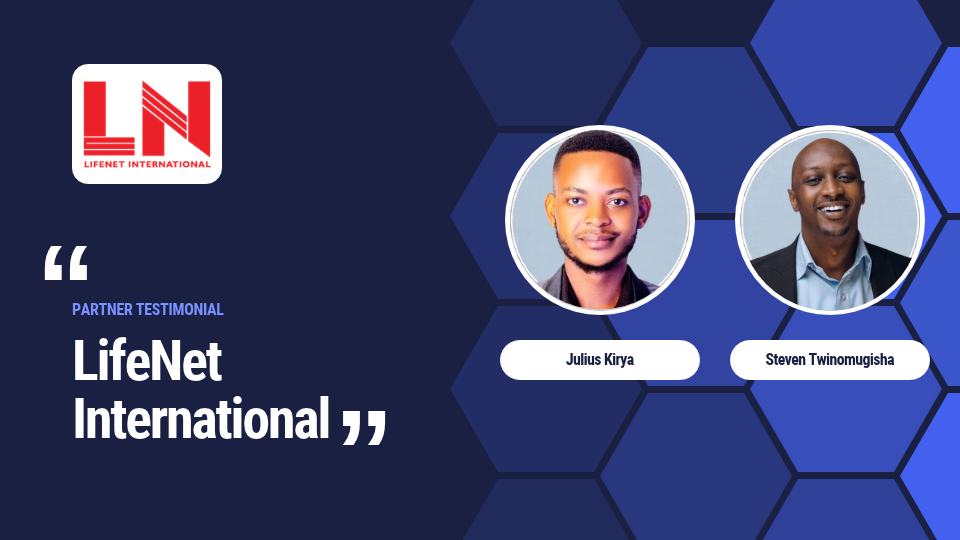
With Julius Kirya, Regional M&E Manager, and Steven Twinomugisha, Digital & Communications Specialist, LifeNet International.
We’re more comfortable here than on any other platform.
LifeNet International works alongside faith-based health facilities across sub-Saharan Africa, helping them deliver care that is high-quality, compassionate and sustainable. Behind that work sits a monitoring and evaluation (M&E) team that needs to know, reliably and across borders, what is happening in-country.
Since 2024, that team has used IASO to collect data in 6 countries: Uganda, Kenya, Burundi, the Democratic Republic of Congo (DRC), Malawi, and Ghana. We sat down with Julius Kirya and Steven Twinomugisha to hear how it has been going, in their own words: where they started, what made the difference, and where they are taking it next.
Before IASO, LifeNet’s data lived in Salesforce. Salesforce made sense at the time: it was easy to manage across several countries, and convenient for the US team to look into the data. Data collected on-site came in through the Formyoula app linked to Salesforce.
As LifeNet’s needs grew, its previous setup began to feel limiting. It was basic to operate, not robust enough for research, and hard to connect to other systems. LifeNet was looking for two things: interoperability, and more control, with one central home for all its data, forms tailored to its own programs, and country teams able to build and run them without outside help.
For data collectors, Formyoula was also one more unfamiliar system to learn, LifeNet needed a tool staff would pick up quickly and remove friction to start.
People are intimidated when they hear about something new,
Julius explains.
But when you tell a new hire that IASO is another form of ODK, with many more interoperability opportunities, they think: this one I can easily adopt.
Chief among those opportunities for LifeNet: a direct connection to DHIS2.
The familiarity Julius describes is concrete. IASO forms are built with XLSForm, the spreadsheet-based standard also used by ODK (Open Data Kit), a widely used open source tool for mobile data collection.
The real test came with a recent maternal and child health study in Uganda. The study was funded research, and the team knew what was at stake if the data didn’t come through.
At first we were skeptical as a team,
Julius recalls.
But we trusted the partnership we’ve built with Bluesquare. We asked Michael Matiashe [DHIS2 Expert at Bluesquare] if IASO would deliver for this study, he said go right ahead, glitches were minimal, and IASO really came through for us.
Michael has worked with the LifeNet team on IASO. And it was no small study.
For our maternal and child health study in Uganda, we had over 30 research assistants on the system at the same time, interviewing more than 2,000 respondents,
Julius says.
We didn’t have to contract any outside developer. Steven and I built it internally using IASO.
Every couple of days, they checked in with the research assistants on how the app and uploads were going. Many interviews took place in communities where connectivity was unreliable, which is where offline data collection mattered most.
Our research assistants were really out in the field, and being able to collect offline and upload later saved us as well,
says Julius.
For LifeNet, one need stands out: working smoothly with the national health information systems (HIS) they operate alongside.
One reason IASO does better is its interoperability with DHIS2. Our previous software wasn’t interoperable,
he says, pointing to how widely DHIS2 is used across low- and middle-income countries (LMICs).
Org units, hierarchies, locations, GPS: I can simply import them from DHIS2, which makes our work much simpler.
In practice, DHIS2 interoperability means LifeNet imports the organization units (org units) and hierarchies already maintained in DHIS2, then links its IASO forms to them instead of rebuilding that geography by hand. The Ministry of Health in Cameroon relied on the same DHIS2 import when it built its national health facility registry with IASO.
DHIS2 interoperability also serves a bigger goal for LifeNet: one home for its data, in place of information scattered across tools.
We want a centralized data bank,
Julius explains,
one place for all the data collection we do as an organization.
The biggest shift may be in who builds the forms. With the previous setup, only a small central team could really operate the system. Today, LifeNet’s M&E leads in each country are system administrators in IASO. They design their own data collection tools, with Julius and Steven on hand to guide them when needed.
The familiar XLSForm approach helped. Staff who already knew spreadsheet-based forms needed only a little guidance to get going, and some now present their own forms to colleagues.
In our meetings and trainings, I see people showing what they’ve built,
Julius says,
as a sign that they’re more comfortable here than on any other platform.
IASO has grown alongside LifeNet. Some features naturally took more time to get comfortable with at first, and several upgrades since 2024 have opened the door to using IASO for research data collection as well as routine monitoring. Steven is candid that getting there was a shared effort, but one done with support:
It took time to understand the breadth of the tool and how much you can do with it,
he says.
A lot of credit goes to Michael for showing us and guiding us.
That hands-on guidance is part of the training and technical assistance Bluesquare provides alongside its tools. LifeNet’s feedback has also become part of how IASO evolves.
IASO is a very flexible and comprehensive tool,
Steven adds.
With the improvements we’ve requested over time, we’re seeing our specific use cases taken into account in the development roadmap.
LifeNet plans to return to communities in Uganda for the study’s endline, the final round of data collection. The conversation with Bluesquare continues too: the team will sit down with Michael to explore how IASO’s and OpenHEXA’s newer AI features can help staff build simple forms and see their results more quickly.
Asked whether they would choose IASO again, both said yes.
Considering where we’ve been, and the IASO team’s attention to detail whenever we made a request, yes,
Julius says.
Our team is far more adaptive to IASO than to our previous application.
Steven agrees:
The support and flexibility of the team behind it is commendable. Having gone through that whole process, I’d still come back to IASO.
At Bluesquare, stories like LifeNet’s shape how we build IASO: alongside the people who use it, in-country, for the long run. Thank you, Julius and Steven, for your time and your honesty.
If your M&E or research team is weighing its data collection options, discover what IASO can do or read more IASO stories on our blog.