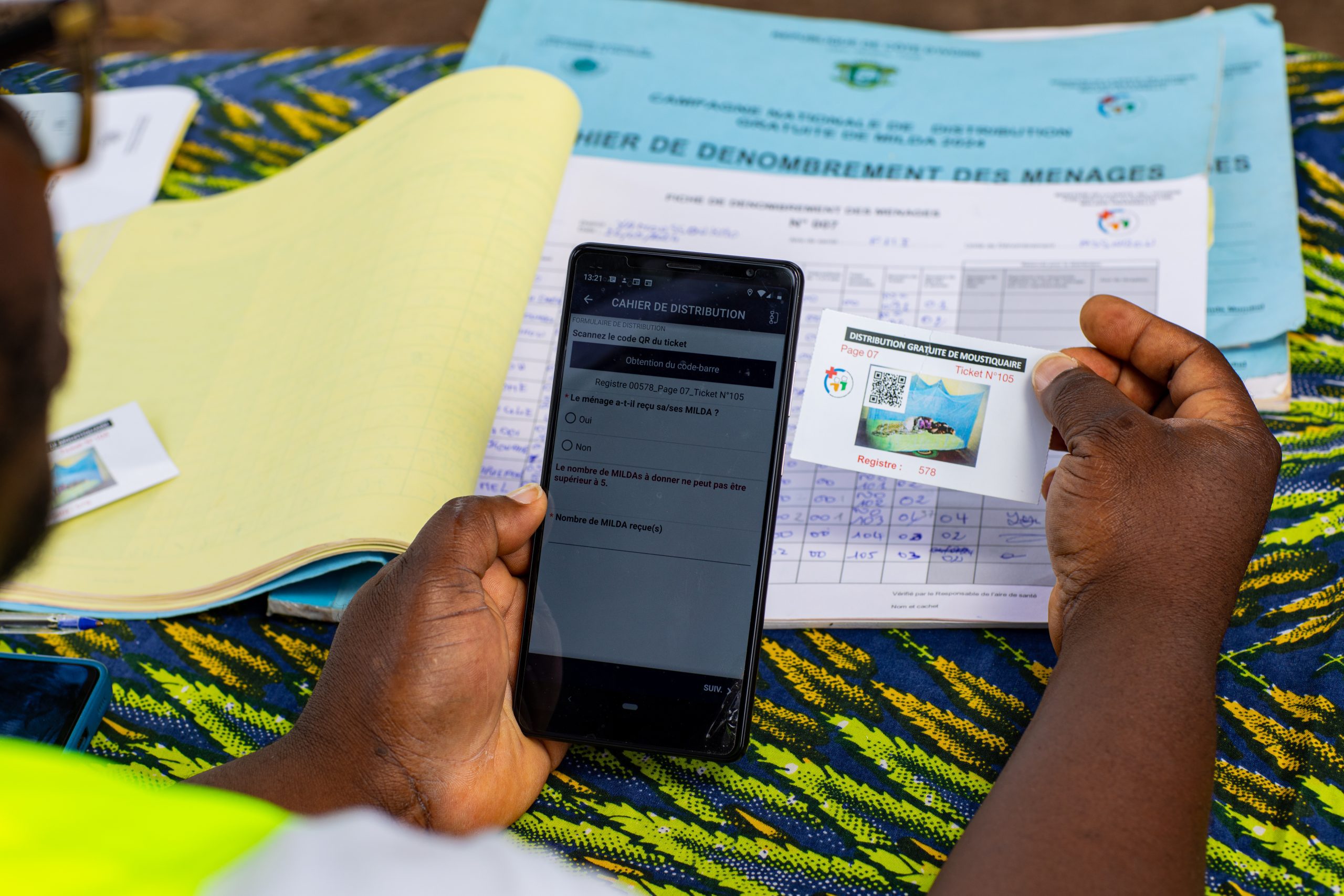
In Niger, malaria remains one of the leading threats to public health. To address it, the National Malaria Control Program (PNLP), with support from its partners, has chosen a simple but effective approach: going on-site to observe how care is actually delivered. This approach, known as OTSS+, aims to identify gaps in care quality and address them without delay, in the health facilities closest to communities. Bluesquare acts as a technical partner to the PNLP, as part of the Advancing Health and Malaria Services (AHMS) project.
In practice, supervisors visit health centers to directly observe providers at work: how a patient is welcomed, how the rapid diagnostic test (RDT) is performed, how uncomplicated malaria is managed, and how malaria is monitored in pregnant women. The goal is not to penalize, but to support by identifying gaps and addressing them without delay.
The numbers show the scale of the effort: between November 28 and December 20, 2024, this supervision made it possible to carry out more than 2,100 observations in 70 health facilities, spread across 20 districts and 7 regions across the country (source: Consolidated OTSS Supervision Report, PNLP, July 2026). This is a periodic activity, carried out 3 to 4 times a year depending on stakeholder availability; the most recent round took place in July 2026.

To make this supervision both rigorous and practical, teams rely on a mobile application: HNQIS (Health Network Quality Improvement System). It is organized around 4 main stages, designed as a continuous cycle:
Another major advantage: the tool works offline. Data collected on-site, even in the most remote areas, is then synchronized to the central DHIS2 platform, where it feeds national-level analysis and decision-making.
This effort is part of the implementation of the AHMS project, funded by the United States and led by Palladium, which aims, among other things, to strengthen formative supervision and care quality in Niger. Bluesquare acts as a technical partner alongside the PNLP.
In practice, our team supports:
But our role does not stop at the technical side. Bluesquare also supports team training on the use of HNQIS, as well as the data analysis and decision-making that follows from it. Well-collected data only has value if it then translates into concrete action on-site.
By analyzing results from 7 districts in the Tahoua region, the teams were able to draw a precise picture of malaria case management quality (OTSS data, December 2024).
Access to management documents works well everywhere, with a regional rate of 97.6% and local scores all above 93%. Availability of technical equipment follows the same trend, with an average of 94%.
This is where the gaps are most pronounced. While the districts of Konni (88.9%) and Bouza/Keita (80%) show good results, Bagaroua stands out with a concerning score of only 14.3%, followed by Tahoua at 33.3%.
Bagaroua stands out positively here, with a score of 91.8%. Conversely, Konni (49.2%) and Madaoua (52.4%) remain below the regional average (62.7%), a signal that calls for stronger support on reporting.
The availability of essential medicines and supplies remains generally adequate, with rates mostly ranging between 70% and 85%.
The supply chain is holding up well overall. The priority now is on two fronts: strengthening provider skills, particularly in Bagaroua and Tahoua, and improving the reliability of health reporting in the districts of Konni and Madaoua.
This is precisely the strength of the OTSS+ approach: turning every supervision visit into another step toward better-quality care, in the health facilities closest to communities.